
Phase 1
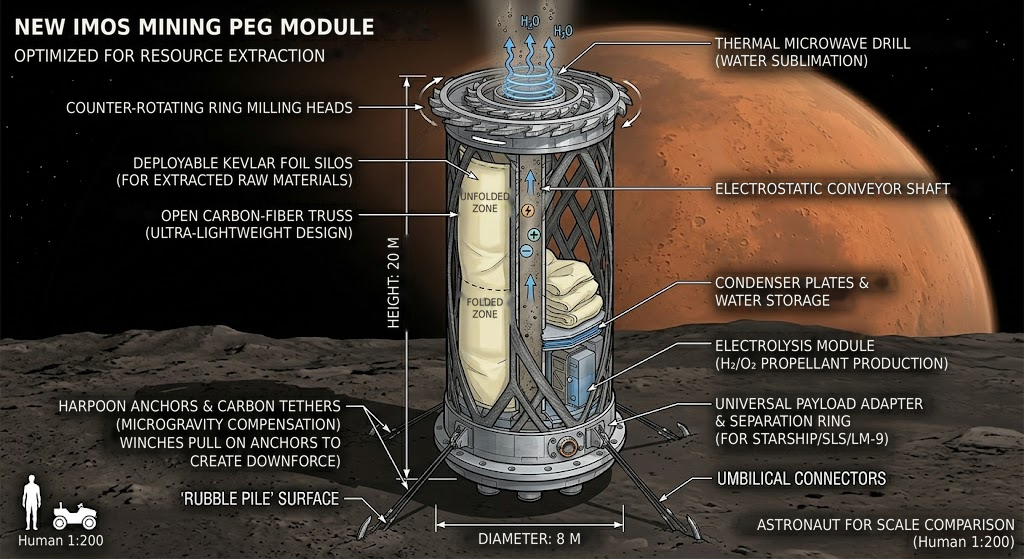
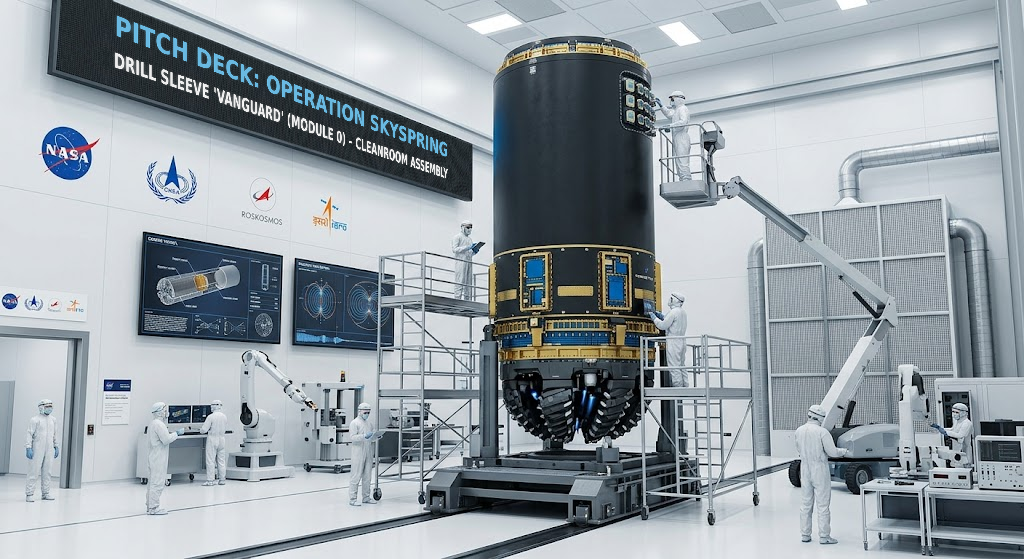
Design of the drill casings and energy modules: engineering of the specialised drill casings, the energy systems (small modular reactors, SMRs) and the life support systems for the crew — designed to fit precisely into the cargo bays of the launch vehicles.
Further work packages in this phase:
- Design of habitats and life support systems for the crew
- Design of carbon nanotechnology systems for tethers and other components
- System integration of the individual modules for launch vehicles (Starship, SLS, Long March, Falcon Heavy, Ariane, New Glenn)
- Launch of exploration and drilling probes to Phobos and Deimos
- Construction of an international spaceport in North Africa (Libya, Algeria), the Canary Islands or Ireland to secure Europe's ability to compete in the global space race
- Design of an offshore anchor station (Pacific) for the conventional space elevator
- Construction of spacecraft with artificial gravity (approx. three) in low Earth orbit to ensure safe transit for astronauts and to respond to emergencies


Phase 2
Transit and Arrival:
- Fleet launch: synchronised launch of the transport fleet carrying the drilling, energy and life support modules to Mars, together with the spacecraft carrying the first crew
- Arrival on Deimos: precision landing and anchoring of the first modules
-
The modular “Octopus” framework features deep-drill anchors, harpoons, or thermal fusion anchors that mechanically anchor the device to the moon’s core. We are building a base structure with eight arms (booms) in space, in low Earth orbit, to deploy it on the moons of Mars. I call it the Octopus. This name is also fitting because the entrance to the main tunnel is located in the center of the framework, where the head of the octopus is. Below this central hub sits the long main bolt, which drills about 50 to 100 meters deep into the regolith of Deimos. We also install numerous pointed bolts under the side arms, into which we can additionally integrate harpoons to anchor the Octopus rock-solid. We mount all the equipment on the booms. We transport this Octopus using a spacecraft, similar to a push-tow maneuver.
Upon arrival on Mars, we set the Octopus on a pursuit course toward Deimos. As soon as the exact orbit is reached, we slow the Octopus down. Deimos pulls ahead and catches up to us from behind. The arms unfold, and Deimos races into the open Octopus.
Translated with DeepL.com (free version)
Phase 3
Water, Energy and Survival:
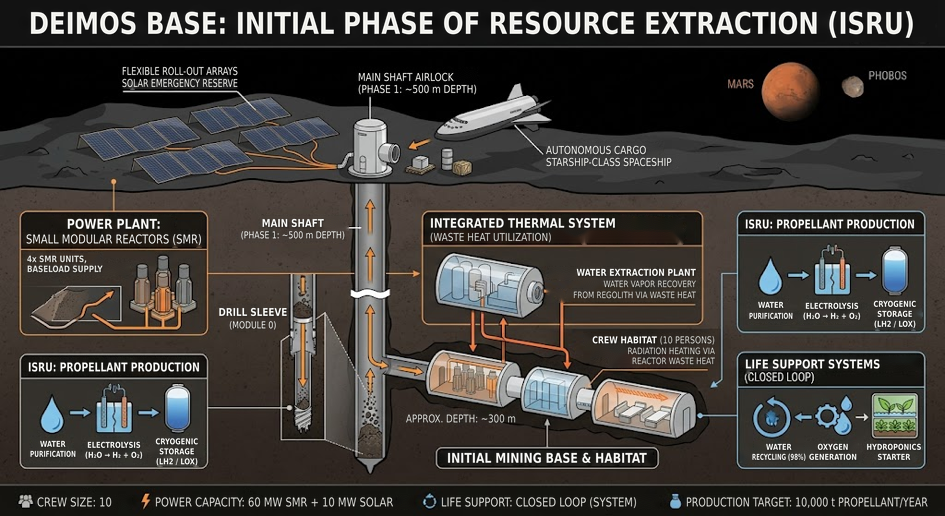
- Commissioning of the SMRs: Activation of the nuclear baseload and deployment of the solar backup arrays
- Water extraction: Start of thermal water extraction from the regolith
- Propellant production: First electrolysis cycles produce liquid hydrogen and oxygen
Phase 4
Mining and Tunnel Systems:
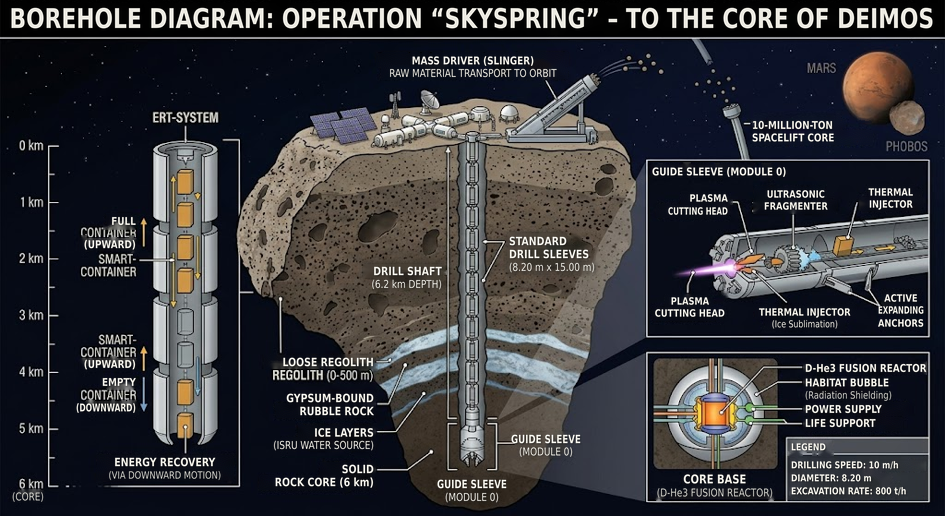
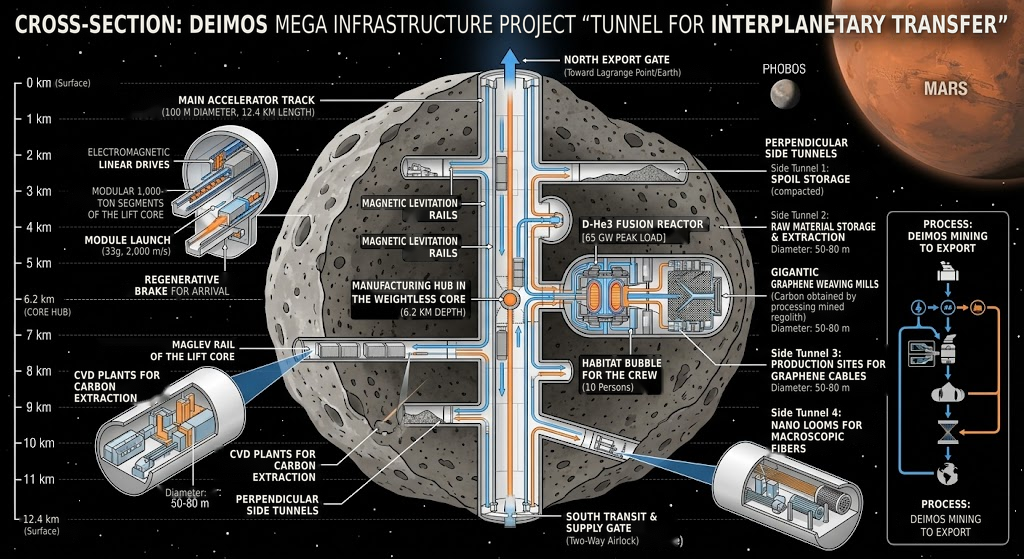
- Construction of the 12.4 km main tunnel: expansion of the main tunnel to a diameter of 50–100 m using ERT systems
- Side tunnel network: halls branching off at right angles for graphene weaving mills and industrial production
- Expansion of storage facilities for liquid hydrogen and oxygen
- Optimisation of the production of hydrogen, oxygen, methane and drinking water
- Construction of habitats beneath the moon's surface
- Intensification of mineral mining
Phase 5
Installation and integration of the production facilities for building the SpaZeLift cores and launching the graphene revolution.
Graphene coatings ("The Fleet's Shield")
Deimos offers a permanent, near-perfect vacuum — the ideal condition for depositing graphene layers onto other surfaces.
Radiation protection: The hulls of autonomous freighters are coated with multilayer graphene. This protects the electronics from high-energy radiation (GCR) better than steel several centimetres thick — at a fraction of the weight.
Heat shields: Graphene coatings dissipate heat extremely efficiently. This makes it possible to produce heat shields for spacecraft that show hardly any wear during re-entry into Earth's atmosphere.
Wear protection: The drill casings for Phobos receive a graphene-diamond coating, which increases their service life in hard rock tenfold.
Structural components ("The Skeleton of Space")
3D graphene printers operating in microgravity can create geometries that would collapse under their own weight on Earth.
Ultra-lightweight frames: Graphene lattice structures for satellites and space stations — 200 times stronger than steel, yet extremely light.
Pressure vessels: Propellant tanks made of graphene composite can withstand extremely high pressures, making the storage of liquid hydrogen (LH2) considerably safer and more space-efficient.
Graphene electronics ("The Quantum Foundation")
As silicon semiconductors reach their physical limits, the next generation of electronics is being built on Deimos:
High-frequency transistors: Graphene transistors switch significantly faster than silicon — the foundation for AI processors that are a thousand times more efficient.
Superconducting magnets: The coils for the 12.4 km accelerator track are manufactured directly on site. Graphene doping makes it possible to achieve magnetic field strengths that are barely feasible on Earth.
The economic multiplier
Graphene-Coated Lenses
Material value: Minimal
Market value (processed): Extremely high
Deimos advantage: Perfect purity in a vacuum
Quantum Sensors
Material value: Milligram range
Market value (processed): Millions of euros
Deimos advantage: No thermal interference inside the rock
Structural Beams
Material value: Tonnes
Market value (processed): Millions of euros
Deimos advantage: Production in microgravity
The heavy silicate cores for the space elevators are manufactured in the main tunnel and fitted with propulsion systems. A finished core is then "launched" out of the moon.
Phase 6
Focus: carbon nanotechnology, core manufacturing of the SpaZeLifts and Lagrange point logistics.
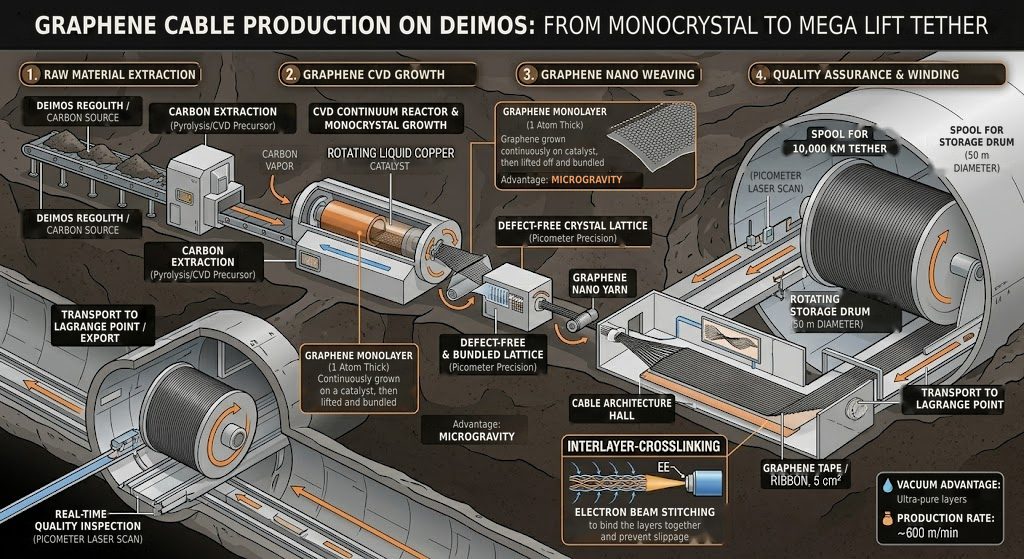
Segment production: Start of continuous production of kilometre-long high-performance tethers.
Microgravity: When carbon atoms are arranged on Earth using chemical vapour deposition (CVD), gravity pulls on the ultra-thin, microscopic filaments — they sag, break or develop atomic defects. In microgravity, the tubes can grow straight indefinitely without buckling under their own weight.
The near-perfect vacuum: On Earth, extremely expensive artificial vacuum chambers are needed to keep out oxygen and moisture. In space, an unlimited vacuum is available free of charge — enabling a level of material purity that is practically impossible to achieve on Earth.
Technical Specifications (Quick Reference)
- Core material: high-performance carbon composites
- Dimensions: as required
- Vertical propulsion: conventional + nuclear thermal engines
- Horizontal propulsion: conventional + electric propulsion (VASIMR / Hall-effect)
- Propellant logistics: interchangeable energy storage modules integrated into the frame
- Rotating flywheel system with movable counterweights in the spokes for the tether drum
